Friday, February 1, 2013

Thoughts (and Feels) on #TEDxUTSC


I hope you’re feeling good UTSC. We’re finishing up week four, and by now we’re already deep into our readings, learning new things every day that make us realize over and over how freakin’ cool it is to study at all. It can feel…cozy.

Tomorrow, starting at 9:30 am, you can tune into TEDxUTSC and catch some more cozy edufeels (you know, like the feels you got the first time you watched Planet Earth?), coming straight from the minds within our school.
I talked to the secretary of TEDxUTSC, Raza Sheharyar. He as well as two other students, Samantha Chiu and Karen Young, went last February to get permission from the school to put on the event. I asked Raza what TEDxUTSC was, what was involved in putting the event on, and what excited him about it. He said that there’s three parts to TEDxUTSC:
So there’s TED; Technology, Entertainment, Design is what it stands for. Anybody that’s seen TED Talks, ted.com, would know what it’s about.The 'x' part indicates it’s independently organized. So TED gives you their brand, they give you their logo, they give you a lot of instructions, a lot of resources, but you are by and large responsible for making the whole thing happen. So getting the funding and everything. And UTSC…the fact that it’s happening at UTSC.
TED is an organization founded in 1984 devoted to “Ideas Worth Spreading.” Since then they’ve expanded from their original mandate of technology, entertainment, and design, into many other things, trying to change the world with TED prizes, Ted Fellowships, Talks, TEDx programs, and more. 

To me, TED (and TEDxUTSC specifically) champions the wealth and brevity of meaningful information available to us because of the internet today. It’s no surprise then that most of the marketing so far has been mostly done online, Indeed, even some of the speakers, like Yusef Dualeh, student/comedian, attribute it to their participation in it. He told me yesterday, “I heard about TEDxUTSC funnily enough, through the TEDxUTSC twitter page. I was tweeted, simply, ‘You should do a talk about your positive outlook’ or something like that. I ended up landing an interview, and then an audition. Now I'm giving the talk of my life in two days and I'm over the moon.”

One of the most intriguing things about this talk is that it’s not just focussed on professors and faculty. Raza said:
This is student organized but at this point we have a lot of support from the school, like A LOT. DSL, SCSU, principal’s office, vice-principal’s office. Like we’re getting funding and other kinds of assistance from other places. We’re not working with any particular student groups specifically, but certainly a lot of students are involved, by making nominations, or just attending or volunteers. At this point it’s pretty campus wide.
It’s messages like this that really make me feel powerful as a student, realizing that if you have a great idea, people will get behind it. It’s important to work for and share these ideas that you really believe in, even if you're not sure they'll work, because chances are, there’ll be a whole ton of other people who will want to help to make it happen.

For example, Yusef told me, “It’s always been a dream of mine to do a TED Talk. I thought I'd get to do something like this by the time I hit age 40 or so. The fact TEDxUTSC has speakers young and old is a testament to how ideas are ageless.”

It’s kind of like, when your prof tells you not to be afraid to raise your hand to ask a question, because chances are, other students have the same question. Sometimes they don’t even realize this question is in them until they hear it.


Check out the TEDxUTSC schedule, posted below, and see if anything piques your interest, set an alarm and pop in whenever you feel like learning something amazing. As Raza said, the whole thing is exciting, “because even if you look through that speaker’s list there’s going to be one or two people that just pop out to you that interest you. Someone you’re dying to see. Like for me it’s Dr. de Sousa. I really want to see him speak. Everyone has their own speaker.”
BTW from what I understand there will be a twitter feed open for live streamers to participate in, it will be monitored (to what extent I’m not sure), for questions too. So be sure to hashtag #TEDxUTSC.


See you on the 'Net UTSC. B-)

UTSC Profiles - The Unspoken Realities


Hello Everyone!

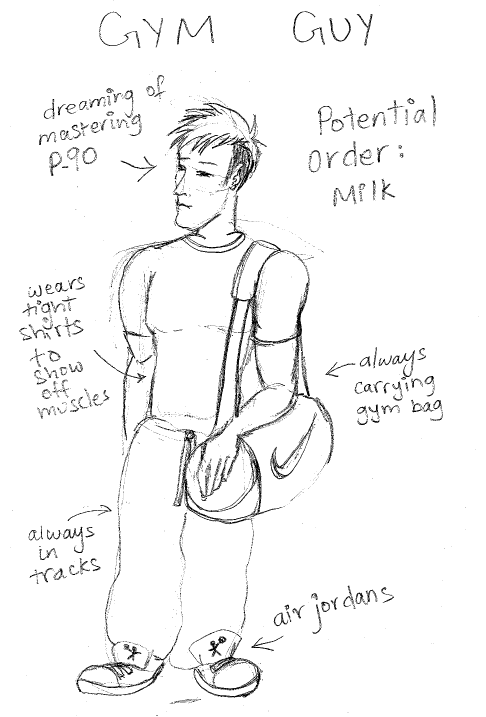
This is week 2 of my caricature on student profiles and this week its the students you find in line at Timmies.

First we have HIGH MAINTENANCE GIRL


Next the GYM GUY


Finally we have COFFEE ZOMBIE/RES STUDENT


I hope you enjoy my mindless musings. I am painfully aware of the bad proportions scale on gym guy.

See you next week

May the force of your GPA be with you

Z

Wednesday, January 30, 2013

Little pleasures

Man, stuff sucks. Here you are at university when all you want to do is slap on your clubbing clothes and party. To make things worse, you have a couple midterms in the next two weeks, and a silly essay due tomorrow that you haven’t even started thinking about. It’s also about to be February, literally the worst month of the entire year, just like the other eleven months. Your shoes are soaked. Your boyfriend/girlfriend is thinking of dumping you; you just haven’t figured it out yet.

I don’t want to sound like a benevolent uncle, or some didactic happiness fairy. Your life actually does suck. But I’d like to encourage you to think of the small ways in which it isn’t insufferable. Here are the small pleasures you can still get from UTSC.

The shawarmas in the H-wing Market Place are surprisingly authentic and are undeniably delicious. I’ve had them for lunch for several days straight, and I still find myself craving them at odd hours.

The sinks in the bathrooms just outside the windy tunnel are very cool; very space-agey. It feels like you’re washing your hands in a pig trough. No really, it’s better than it sounds

The exhibits in the Doris McCarthy gallery are usually very nice. You can just waltz right in and look at pretty things, and the curators don’t even bite.

Lecture rooms in the newer buildings, like MW, have outlets on every table. Right there, waiting for you to use it. It’s so convenient! You can go on Facebook the whole lecture without having to worry about your battery.

The library is now a place where you can actually study. Seriously, try it. It’s a revelation. You might find yourself being able to read in a library.

The little counter on the water refill stations telling you how many plastic bottles were saved, especially when it goes really high because you weren’t paying attention to how full your bottle was and half the water goes down the drain.

The IC building during sunset, a somehow life-reaffirming sight.


Your favourite cute waiter at Rex’s Den.

Watching Dr Phil while on the treadmill in the Athletic Centre, which reinforces your sense of smug superiority because you’re exercising and changing your life instead of being overweight and crying about how your daughter is a prostitute.

Being able to tell your siblings or your friends, “Aha, because of what I learned in my behaviour analysis class, I know you’re actually an idiot!” This, I feel, is what the university experience is all about.

5 ways to slow down the 'going broke' process

So the beginning of the semester is good news for many of us. 'Why?' you ask. How could the commencement of yet another grueling, course-filled four months be good news? Well first off, here’s hoping y’all have friends because they usually make life a little better. University is no place to be eating your lunch in the toilet stall, time to leave the safe zone and let life begin.

ANYWAY BACK TO MY ORIGINAL POINT. Why is the beginning of the semester great for many of us?
One word: OSAP
Or is that four letters? I don’t know. Or maybe even, one word: RESP. Obviously this  'one word’ endeavor has failed spectacularly.

Then there are those like moi, who don’t have the monstrously dangerous benevolence of OSAP in our lives. For me, the new semester brings with it a whole new cornucopia of the anxiety and panic that define my existence. More specifically, I am blessed enough to be reminded by a cute ‘lil webpage that I AM POOR.  To be honest, there is nothing more depressing than online banking. At least in the olden days, you could put off going to the bank and just delude yourself into thinking life wasn’t crashing around you. This whole one-click-away crap has definitely spiked depression rates amongst kiddos like me. Maybe I’ll conduct a study of some sort.


I HAVE STRAYED YET AGAIN.  Anyhoo, the realization that my finances are in shambles usually motivates me to make some sort of really colourful chart detailing my expenditures. It’s a vicious cycle since often, I venture out to the store to buy MORE stationery for purposes outlined above. Then I get to write THOSE new expenditures on my chart with my colourful new pens! Since not all of you can benefit from the pure, undiluted genius that inhabits my brain, I will share with you, 5 tips for saving money in college.

DISCLAIMER: Like every other ‘list’ I make, this too, contains information you already know, but if I can’t make writing material out of your delusions and escapism...What am I to do?

Please, mum.


5 WAYS TO SLOW DOWN THE ‘GOING BROKE’ PROCESS

     Don’t buy textbooks until at least the 3rd week. Most Profs (unless they are angels from above) will encourage you to buy the book. Then you will realize that 80-120 bucks you wasted on a text you have barely touched. It’s better to screen these things before pooling your moollah into them.


      AVOID VENDING MACHINES. Yes, I know they’re right there and it’s so easy to just pop a coin in and get whatever pop or unacceptably sketchy sandwich you want. But facts are facts people; you may for a 2 litre bottle of pop, what you would for a 591ml one at a vending machine.  I know what you’re thinking, “How the hell am I supposed to carry a 2 litre bottle of pop to class?” You don’t have to; a carton of cans is ALSO about 70% cheaper than the same number of cans bought individually at a vending machine. These costs accumulate. Your little pocket of change will be completely depleted in a day if you continue to buy from vending machines unless you absolutely HAVE to.
Vend-zilla

      STOP BUYING TEA AT TIM HORTONS. They put a teabag in water dude. You can do that yourself. You’ll probably find some cool lucrative way to do it that makes the tea taste better somehow. Where you pay between $1.20 – 2.00 on tea at these campus stores, you could spend the same money on an entire pack of tea bags and make tea every day at home or on campus. Invest in a hot mug or even just a regular one and drink hot tea as many times a day as you want. We have microwaves, you can keep reheating it. The same goes for coffee, you can just buy coffee beans at your favorite place and make those at home. Also, it’ll reduce the amount of time you spend in that ridiculously long line.


Whole box vs one measly cup?

      Share books with friends. If you’re in a course with a friend, which you likely will be in your upper years. Then go halfsies on textbooks. Not only will it greatly reduce your costs (especially if you buy a used book), having one book will motivate you to study together as opposed to alone. You can push each other!
Maybe be more friendly when sharing books with the pals

      Keep your receipts. Every ATM on this campus is littered with the carcass of the many receipts students discard. Most of us don’t even really look at them. It’s why we develop misconceptions about our finances. You have to TORTURE yourself and scrutinize them, watch as the figures go further down with every purchase and FEEL the poverty creeping up on you. The next time you spend $10 bucks on a meal that you aren’t hungry enough for, the haunting image of that tiny chit of paper will salvage whatever remains in your wallet.

Every single time I look at my receipt.


                        G'day to you all !


Friday, January 25, 2013

When in doubt, send it out

OK guys, guyettes, etc. I know what you're thinking, "Seriously another post by this schmuck!? I thought they got rid of him. I was already yelling 'good riddance' and counting my blessings, etc.! How come he gets to publish his work at UTSC every week and I don't? I'll show him."

Well here's what I'm thinking, "Oh you wanna show me, eh? Prove you got the stuff, huh? Well go ahead, I dare ya, send some stuff to Scarborough Fair. IF YOU'VE GOT THE GUTS."

Yeah, I know what you're thinking, "Scarborough Fair, what's that? Is it nearly as cool or really cool as the UTSC:Pulse student blog?"

Well let me tell you one more time what I'm thinking: "Look, PUNK. This annual journal is going to get distributed into around one thousand, five hundred hungry little hands starving for UTSC's creative juices. Literally dying to see what you're made of. Just imagine, each of these people will go through the book, find your work, get immediately blown away, and they'll have to show it to one other person (or they'll die, seriously). Someone will walk by in the hallway, see that person looking into Scarborough Fair, see your work (absorb the entirety of it's awe-some-ness in less than half a second), and fall to their knees, grovelling to the book. They'll let out a yell that will thunder through lecture halls everywhere, "We're not worthy!" See? That's at least three thousand people's voices praising your name if you submit. DO YOU THINK YOU'RE READY?. 


Oh, you make visual art? Paintings? Digital art? You have photos of your cool sculptures? You write Poetry? Short stories? Literary Essays?  etc.!? Who cares! YOU GOTTA SHOW OFF YOUR POWER FOR IT TO MEAN ANYTHING. What, are you worried you're not gonna get accepted? I'm gonna submit this picture, just to show you it doesn't matter if you don't think you're good enough.

I swore an oath that I'd never reveal who helped me make my magnum opus.
Seriously, the editors are gonna look at this and wanna quit their jobs, right? YOU CAN BEAT THIS. YOU WILL GET IN. PEOPLE WILL FINALLY APPRECIATE YOU AND NOT JUST WANT YOU GONE FROM THEIR LIFE. In short, I'm challenging you to a duel. 

Don't make gifs at gifsoup. I do not endorse that watermark.
Deadline for submitting written work is February 1st. February 8th for visual art. See website for details. Also be sure to check out the past issue to see what it's like!


PS. If you don't get in they're just str8 h8rs, keep on twerkin' your stuff. EXAMPLE: My art, as seen above, always gets rejected for some dang reason.
PPS. I still keep submitting the same piece of perfection every year, regardless.

Thursday, January 24, 2013

CSIP - Campus Student Investigative Profiling

Hello all!

As I sat around reading all my fellow bloggers posts and admiring their work I had a realization. Suddenly I felt like they were all so creative and eloquent and I was dragging me feet in the halls of creative writing. Thus I decided to cut the writing bit down and instead draw for you all!

WALLA! Week 1 of 'Zarish-Drawing-in-a-desperate-attempt-to-make-use-of-her-studio-art-degree-valid' commences!

This week I have compiled some rather stereotypical characteristics of art vs. management vs. science students. Bearing in mind people are individuals and not everyone is subject to this heavily artistically licensed sketches...

Not that we have the disclaimer out of the way I bring you!!

ps. forgive the sub-standard scans the scanner at st.g couldn't handle my 1.5 ft x 1.5 ft sketchbook (sigh)

MANAGEMENT


ARTS


SCIENCE 


THOSE IN-BETWEEN


Next week will be the special UTSC edition! Keep your eyes out and comment if you have a specific 'type' you'd like me to cartoonify.

Till then.....

<3 Z

Wednesday, January 23, 2013

Videogames, motivation, and university


Everyone likes videogames. They’re an escape from the doldrums of real life. They offer challenge, reward, and a feeling of mastery. Many of the most addictive ones use every Psychology 101 trick in the skinner box to keep you playing, and do so well that videogame addiction has become a legitimate public concern. Whether on your smartphone or your gaming PC, games are a constant, gnawing distraction, and exploit the psychology of motivation to powerful effect.

Even when they cease being fun, games still motivate players to keep playing (e.g. “grinding” in an MMO). Many, many games, from Farmville to World of Warcraft include grinding (repetitive tasks in the game for in-game rewards). In other words, games still engage even when they feel like work. People will still play them even if there is no real-life reward for their efforts. If they knew this, parents around the world would be asking “So why aren’t you doing real work?” Clearly, real work has a lot to learn from videogames.

Grinding in MMOs shows gamers continuing to play a game, even after it starts to feel like work

Thankfully, the real world is catching on. “Gamifying” the workplace is a growing practice in firms, and involves injecting elements from videogames into otherwise boring jobs to make them more rewarding. Tech-industry research company Gartner estimates that by 2014, 70% of of large companies will have used gamification techniques in some way or another to motivate their employees. For example, at IBM employees earn Kudos Badges (sort of Xbox Live Achievements or Playstation Trophies) for completing certain tasks, that show up on their company profile. By earning a set number of Kudos points, they rise in rank from a virtual status of Rookie, Pro, Veteran, etc. At Xerox, employees in management training complete on-the-job Quests, and their completion is ranked on a company-wide leaderboard, adding some friendly competition into the workplace. So far, gamification is an effective and popular way to drive up the performance of employees.

IBM's Kudos system takes cues from Xbox Live

And yet, somehow, school has been left behind, despite a rapidly changing student populace. “Traditional instruction methods lack the motivational incentives needed to keep today’s students engaged in the instructional content,” writes Petkov and Rogers in the paper Using Gaming to Motivate Today’s Technology-Dependent Students. “Today’s world and today’s students are vastly different than the way they were a few decades ago. Educational methods that have worked on past generations of students are not as effective for today’s technology-dependent generation.”

Modern university education is still strangely reliant on didactic “learn through listening” education instead of “learn through doing,” and still almost exclusively relies on extrinsic motivation to get its students to study and pass, instead of the more effective intrinsic motivation.

Extrinsic motivation is formed based on the external rewards you get that motivate you to complete a task, such as money and getting a good grade. Intrinsic motivation is the inherent pleasure you get from doing something, which naturally motivates you to continue. So far, universities rely almost entirely on extrinsic motivation to get you to do the work and pass your courses—if you do, you’ll get a good grade and get your degree and get a good job and you won’t be a waiter for the rest of your life.

The problem with extrinsic motivation is that it stifles the intrinsic pleasure you get from an activity. Say you like to play the piano, so you keep playing piano whenever you get home from school. Your parents love the fact that you’re playing piano and so they give you $5 every time you do. This is a mistake. Now, somehow, you lose your motivation to play the piano when your parents don’t pay you. You come to rely on that extrinsic reward. Your intrinsic motivation has been erased. Your parents stop paying you, and the chances significantly decrease of you ever playing the piano again.

It’s the same thing with university. The whole purpose is to teach you how to learn, to make you want to learn, and keep learning, for the rest of your life. They keep you studying because of that extrinsic motivation—your grades—but what happens when that extrinsic motivation goes away? I think for most people their motivation to study significantly decreases. Universities raise generations of adults who become much less curious as soon as they leave school.

The pervasiveness of electronic distractions in class shows that universities need serious help in engaging the tech generation

But what if universities raised generations of adults who loved learning just for learning's sake? If they’re motivated to learn because university taught them that learning is fun? The same people (97 percent of young people, according to recent data) who play games for pleasure would eagerly learn in new, interactive ways because of the same reasons that they game. And what if universities downplayed the role of extrinsic rewards like grades, instead trusting that they educated a group of smart, motivated adults who are curious about the world?

Assassin's Creed's Jerusalem is vast and historically accurate

Imagine a history class where you played Assassin’s Creed or another historical game; not just having a professor talk your ear off but feeling like you’re actually there—a history that you can immerse yourself in and interact with. Imagine a leaderboard for high test scores, or achievement medals for completing certain classes or doing certain tasks reading a particular book. Imagine a university where learning is not only interactive and fun, but full of a sense of accomplishment because of micro-rewards and an increased social and competitive aspect. Instead of playing Angry Birds on your phone, maybe you’ll complete some calculus problems (for points!) instead.

In a world of exponential technological progress, universities have to adapt to capture the attention of the tech generation. If IBM is capable, so is U of T.